Details You Don’t See: Flooring Transitions
Let’s spend some time getting technical. There are certain details in a beautifully finished home that I hope you never notice. I know that probably sounds strange coming from an interior designer. After all, shouldn’t I want you to notice the details?
Yes. But some of the best details are the ones that look so effortless you never stop to think about how much planning went into making them happen. A flooring transition is a perfect example and that is what we are going to break down today.
Imagine that you walk from beautiful hardwood flooring in your hallway into a tiled bathroom and the two floors meet almost perfectly. No awkward step up. No bulky transition strip interrupting the doorway. Nothing catches your eye. You probably just keep walking. Meanwhile, your designer, builder, and installers may have had multiple conversations about fractions of an inch to make that moment happen.
Welcome to the technical world of interior design!
A Seamless Flooring Transition Starts Long Before Installation
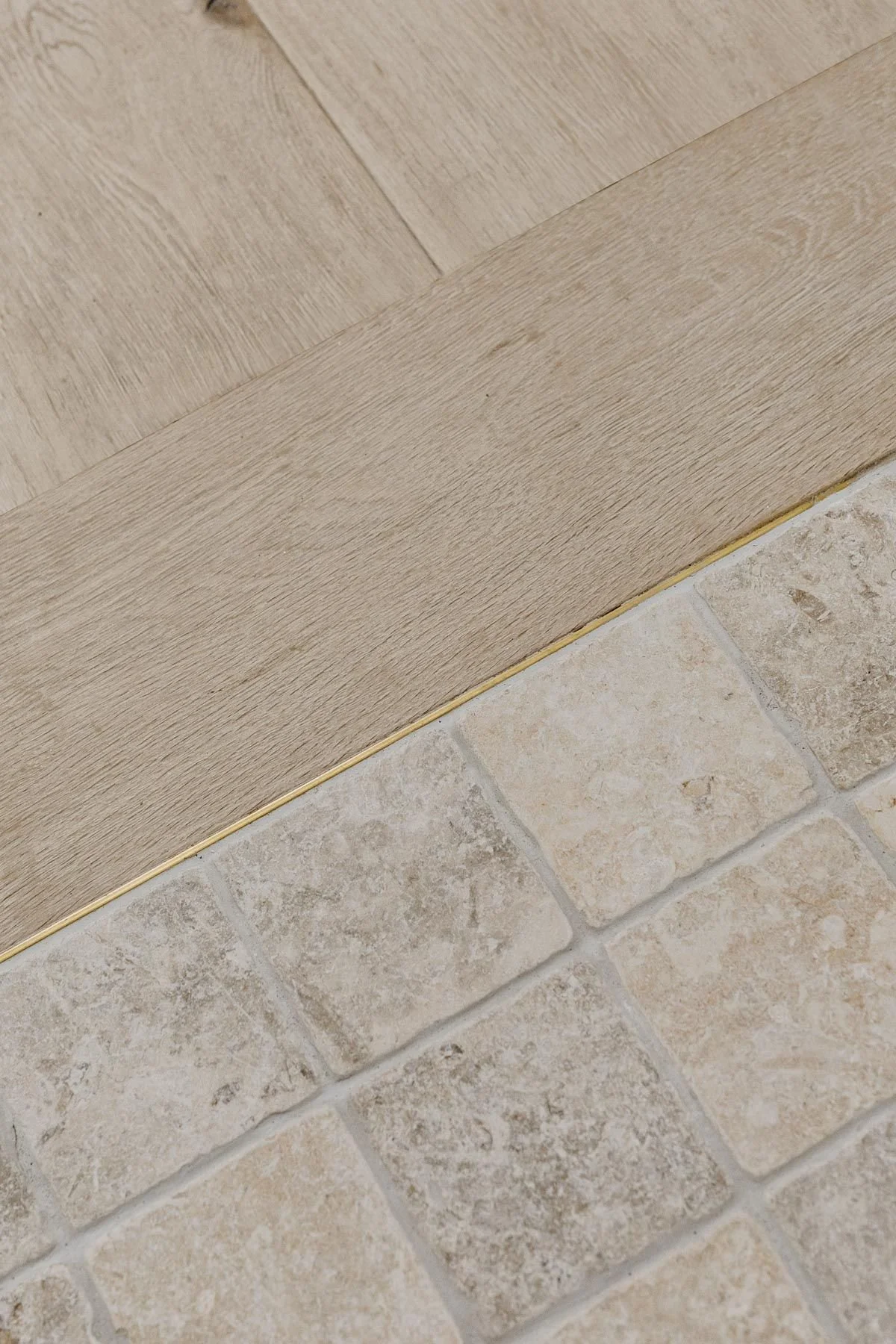
When I'm selecting flooring for a new build or renovation, I'm not only looking at the color, finish or whether a particular tile looks beautiful next to the hardwood. I'm also looking at how thick everything is.
And this is where something that sounds incredibly minor can become surprisingly important. Floor tile itself may be around 5/16 or 3/8 of an inch thick, although the exact measurement varies considerably by product. For example, Daltile has some porcelain floor tile at 5/16 inch, while other porcelain products are approximately 10 millimeters, or roughly 3/8 inch.
But the tile is only part of the equation.
Underneath it, we also have to account for the installation assembly. Depending on the application, that can include mortar and an underlayment or membrane. All of those layers contribute to the finished floor height.
Then we have the flooring on the other side of the doorway. Let’s use engineered hardwood for the other side of the door.
Engineered hardwood isn't one universal thickness. Real Wood Floors, one of the flooring sources I personally love using, offers engineered hardwood in several different overall thicknesses. For example, their Eighteen Seventy Five collection is 3/8 inch thick, Killarney products such as Kells are 1/2 inch thick, the Overture collection is 9/16 inch thick, and collections such as Velasario are 5/8 inch thick.
So imagine selecting a beautiful tile for a bathroom and beautiful engineered hardwood for the hallway without considering any of those measurements. Both look perfect on the sample board. Then they're installed. And suddenly one finished surface sits higher than the other. Now we have to solve a problem that would have been much easier to address before installation began.
This Is Why We Look at the Entire Flooring Assembly
When we want that beautiful, nearly flush transition between hardwood and tile, we have to work backward from the finished surface.
How thick is the tile?
How thick is the engineered hardwood?
What is underneath each one?
What will the final installed heights be?
Does something need to change in the subfloor or underlayment?
Will we need a transition piece?
And where exactly will that transition happen so you don't see an awkward strip of bathroom tile sticking out underneath the closed door?
These are tiny decisions individually, but together they affect whether the finished home feels thoughtful.
Sometimes a perfectly flush transition isn't possible or isn't the right construction solution. That's okay too. There are transition profiles specifically designed to accommodate adjoining floors at different heights. The important part is that we're thinking through that condition intentionally rather than discovering it at installation.
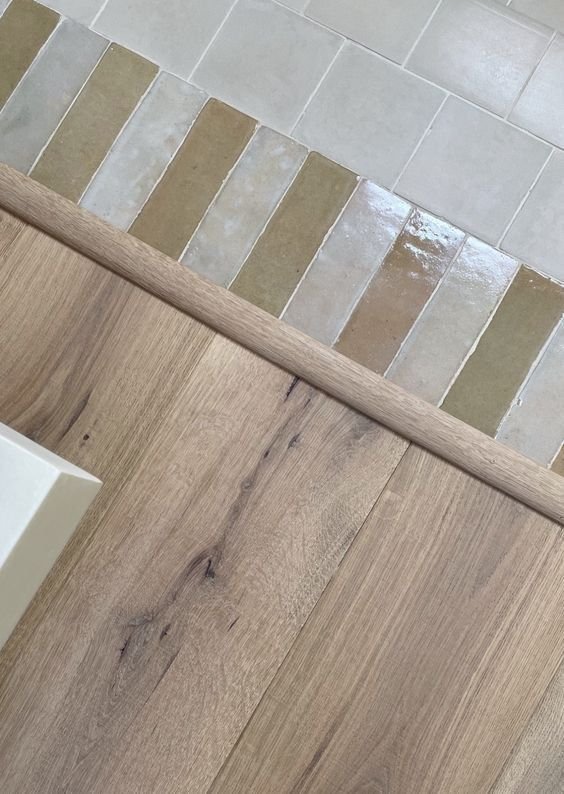
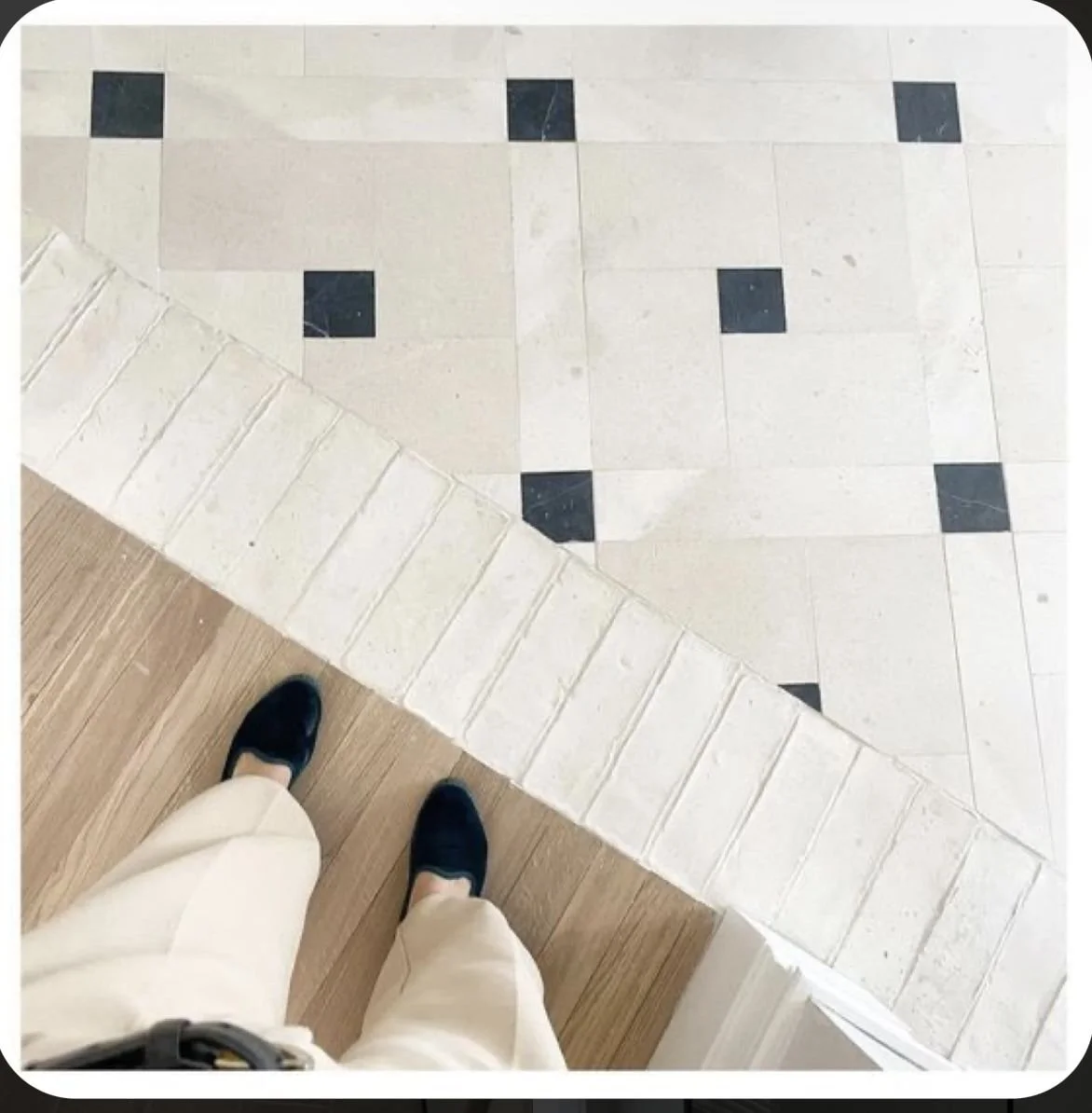
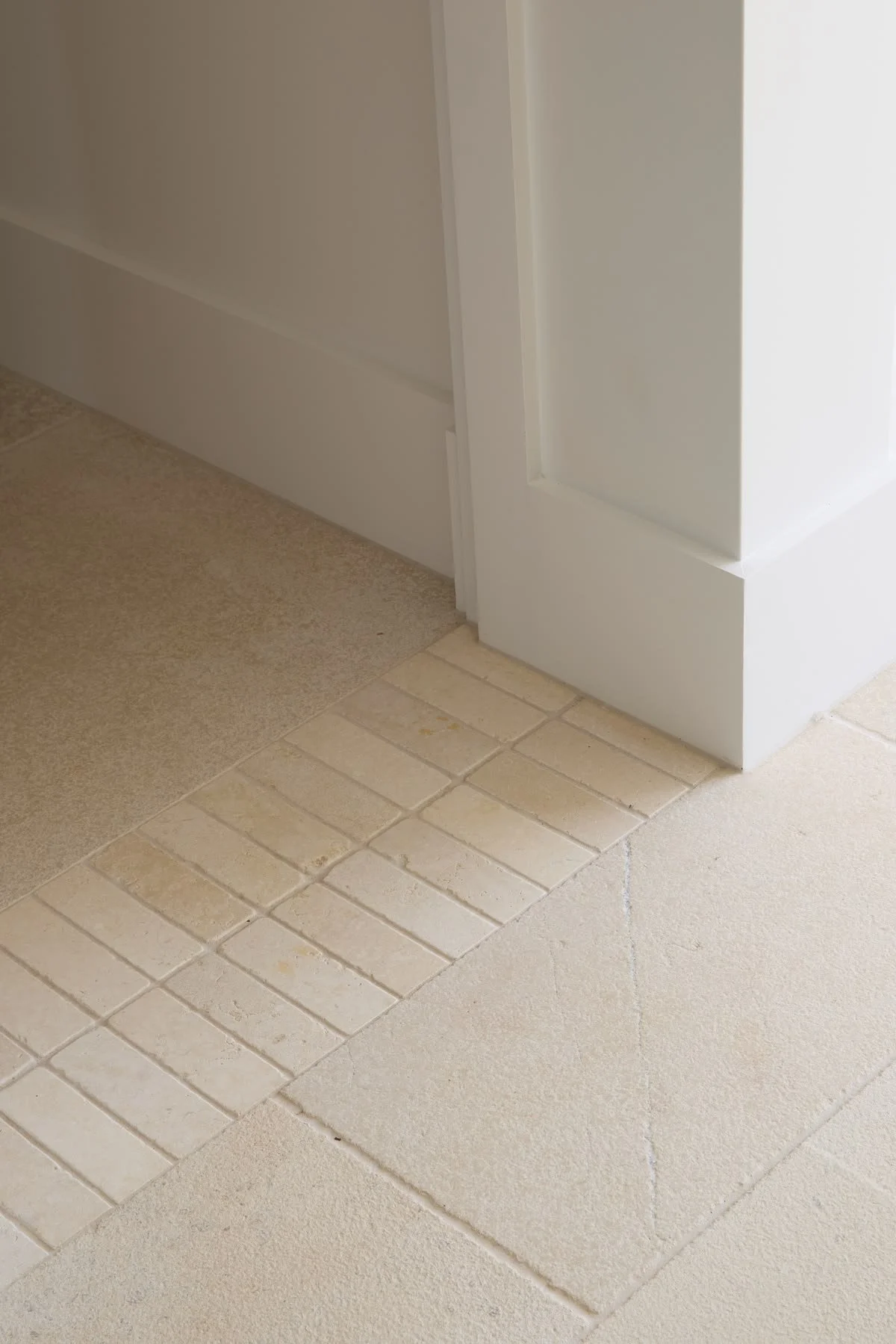
Another Flooring Detail I Always Look At
While we're talking about flooring thickness, there is another number I want homeowners to understand: the wear layer.
Engineered hardwood is real wood flooring, but it isn't constructed the same way as traditional solid hardwood. It is made from multiple layers with real wood forming the top wearable surface. Solid hardwood, by comparison, is one piece of wood from top to bottom.
That difference matters when we start talking about the future and longevity.
A quality solid hardwood floor can typically be sanded and refinished multiple times over its life. Engineered hardwood may also be refinished, but its ability to do so depends heavily on how much real wood is available in that top wear layer. And the difference between products can be significant.
Again, Real Wood Floors gives us a really nice real-world comparison here too. Their engineered products aren't all constructed with the same wear layer. The Eighteen Seventy Five collection has a 1.5 mm wear layer, Kells has 2 mm, Velasario has 3 mm, and some Vintage Loft products have 4 mm.
This is why I don't want a client to hear the words “engineered hardwood” and assume every product is essentially the same. Two floors can both be real engineered hardwood and still have very different overall thicknesses and very different amounts of usable hardwood at the surface. Those specifications affect not only how we coordinate the flooring with adjacent materials today, but potentially what you can do with that floor years from now.
That doesn't automatically make one product right and the other wrong. It does mean I want to understand what we're specifying and why. If you're building your forever home and you're choosing a floor with the hope that it can eventually be sanded and refinished, that's a conversation worth having before we order it.
“When you look at a completed home, I hope you're thinking about how beautiful it feels.”
I hope you're noticing the natural light, the cabinetry, the flooring, the furnishings and all the ways the spaces flow together. I don't particularly want you standing in your bathroom doorway thinking, Wow, someone really nailed those finished floor elevations. Let’s be honest. noone does that.
The point is that thoughtful interior design isn't only about choosing beautiful materials. It is also about understanding how those materials come together. A tile can be gorgeous on its own. An hardwood can be gorgeous on its own. But someone still needs to ask what happens when the two meet. And ideally, we're asking that question long before the installer arrives.
This is one of the reasons I believe an interior designer should be involved early in a new build or major renovation. There are hundreds of decisions like this hiding underneath the finished photographs. Some are aesthetic. Some are technical. And many are both. A seamless flooring transition isn't going to be the star of your home. It probably won't be the thing you show your friends when they walk through the door.
But when it's done thoughtfully, everything simply feels right.
And sometimes, good design looks effortless because someone spent a lot of time making sure it would.
At Effortless Designs, we help families throughout Athens and Northeast Georgia think through both the beautiful decisions and the details you may never realize needed to be made. Because whether we're designing a new build or a large renovation, our goal isn't simply for your home to photograph beautifully. We want it to be thoughtfully designed all the way down to the details you don't see.